



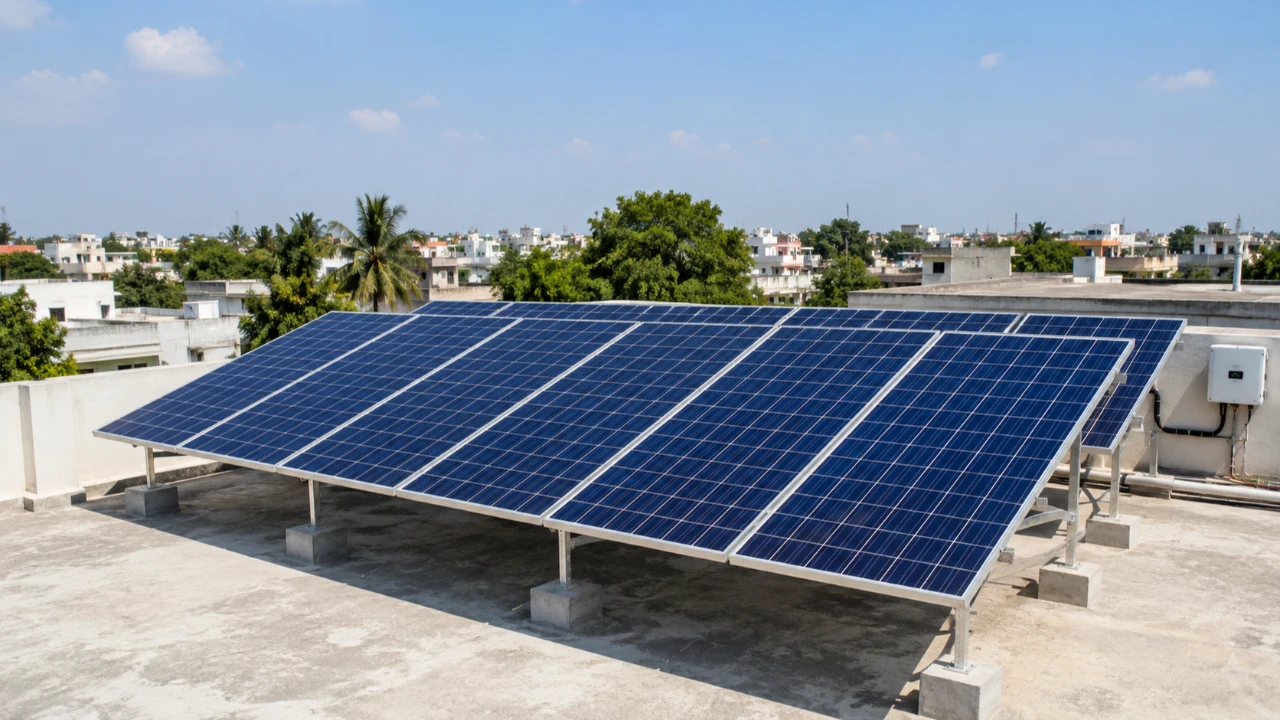
Introduction
Solar panels for housing society are increasingly being considered as a practical way to manage common-area electricity expenses. A well-planned installation can supply power for lifts, pumps, lighting, security systems, and other shared facilities while reducing dependence on grid electricity. However, the project cost depends on site and system factors, while the financial return needs to be assessed against actual consumption and tariffs.
Let's learn how solar panels for housing societies are priced, financed, and evaluated for ROI.
What Determines the Solar Cost for a Housing Society?
The final price depends on electricity demand, usable roof area, system capacity, and equipment selected. A cost estimate should therefore begin with a technical and financial assessment rather than a standard per-kilowatt figure.
Review Electricity Consumption
Start with 12 months of common-area electricity bills. Review consumption and the tariff paid to the DISCOM to estimate system capacity and potential savings.
For instance, if a society uses around 112,000 units annually and a suitably designed system generates about 1,400 units per kW each year, the indicative capacity would be about 80 kW.
Check Available Roof Area
A society needs unobstructed roof space for panels, mounting structures, and maintenance access. Shadows, roof condition, and structural strength should also be assessed before installation.
Confirm the Electrical Setup
The sanctioned load, electrical distribution, and proposed solar capacity need to be reviewed together, along with the inverter, metering, and grid connection requirements.
Understanding the Price Range of Solar for Housing Societies
The cost of solar panels for housing society projects varies with system size, module technology, inverter specifications, mounting structures, installation requirements, and other balance-of-system components. As an indicative reference, housing-society systems may fall around ₹45,000 to ₹65,000 per kW, although a project-specific quotation can differ based on the site and equipment.
Consider an illustrative 80 kW project priced at ₹55,000 per kW. The estimated project cost would be ₹44 lakh before any applicable subsidy or other financial support. If the system generates around 112,000 units annually and the society's effective electricity value is ₹9 per unit, the potential annual energy-value saving would be approximately ₹10.08 lakh.
Estimated payback period = Net project cost ÷ Annual savings
At these illustrative figures, ₹44 lakh ÷ ₹10.08 lakh gives approximately 4.4 years. This excludes financing costs, maintenance, tariff changes, and other project-specific factors, so it should not be treated as a guaranteed ROI. The actual return from solar panels for a housing society depends on generation, electricity tariffs, system uptime, and the final project cost.
Financing Options for Housing Societies
The upfront investment does not have to come from one source. Housing societies can evaluate financing based on their reserves, cash flow, and borrowing capacity.
Use the Society's Corpus
A society with adequate reserves may allocate part of its corpus towards installation, while retaining funds for maintenance and emergencies.
Consider OPEX Financing
Under an Operating Expenditure financing (OPEX) arrangement, the provider typically invests in and operates the system while the society pays for generated electricity. The agreement should define tariff terms, tenure, maintenance, and ownership.
Use a Bank Overdraft Facility
An overdraft facility may suit societies with an established banking relationship. Review interest rates, borrowing limits, and repayment terms before proceeding.
How to Choose the Right Solar for Your Housing Society
Cost should be assessed alongside system design, service capability, warranties, and the provider's ability to support the installation over its operating life. A lower initial quote may have different equipment specifications or service coverage, so compare proposals on a like-for-like basis.
Check Technical and Project Experience
Review similar projects and ask for system specifications, expected generation, warranties, mounting details, cost breakdowns, and monitoring arrangements.
For a society considering rooftop solar for housing society applications, the proposal should account for roof access, common-area load, electrical infrastructure, and maintenance requirements rather than treating the site like an individual home.
Seek a Solar Partner with the Right After-Sales and Maintenance Capabilities
After-sales support is an important part of the ownership cost. Regular inspections, cleaning, performance monitoring, troubleshooting, and timely repairs can support consistent operation and reduce avoidable downtime.
Eastman Auto & Power Limited provides a broader solar and energy ecosystem supported by its manufacturing and R&D capabilities. Its stated infrastructure includes:
- 8 Manufacturing Units
- 3 R&D Centres
- 2 Million Units Power Electronics Manufacturing Capacity
- 11.47 GWh Battery Energy Storage Capacity
- 24x7 Service Support
- 2-Hour Service Response Time
- One-Stop Solar Solution
Eastman's manufacturing infrastructure also covers solar panels, power electronics, and energy storage products, supporting an integrated approach to solar projects.
Compare the Full Project Cost
Request a quotation covering equipment, installation, metering, commissioning, monitoring, warranties, and maintenance. This makes it easier to compare proposals and identify potential additional costs.
Assessing ROI for Solar Panels for Housing Society
Calculate ROI using the society's own bills. Key inputs include installed capacity, annual generation, tariff, project cost, maintenance, and financing costs.
An 80 kW system generating around 112,000 units annually could offset common-area consumption if the roof and load profile are suitable. Post-installation monitoring can compare projected and actual generation.
Solar panels for a housing society can therefore be assessed through feasibility, upfront cost, financing structure, and expected payback. A detailed proposal for solar panels for a housing society should show these assumptions clearly so committee members can review the investment transparently. A solar panel for an apartment society should similarly be sized around actual shared electricity demand rather than the number of flats alone.
Making a Practical Solar Investment Decision
The economics of a society solar project depend on electricity demand, roof conditions, and financial capacity. A clear quotation, realistic generation estimate, and maintenance plan make ROI easier to assess.
Solar power for housing society projects can support lower common-area electricity costs when appropriately designed and maintained. With its manufacturing capabilities, energy solutions, and service support, Eastman is a suitable partner for housing societies looking to plan and manage a solar project.
 78728 78728