



 January 15, 2026 / Solar Batteries
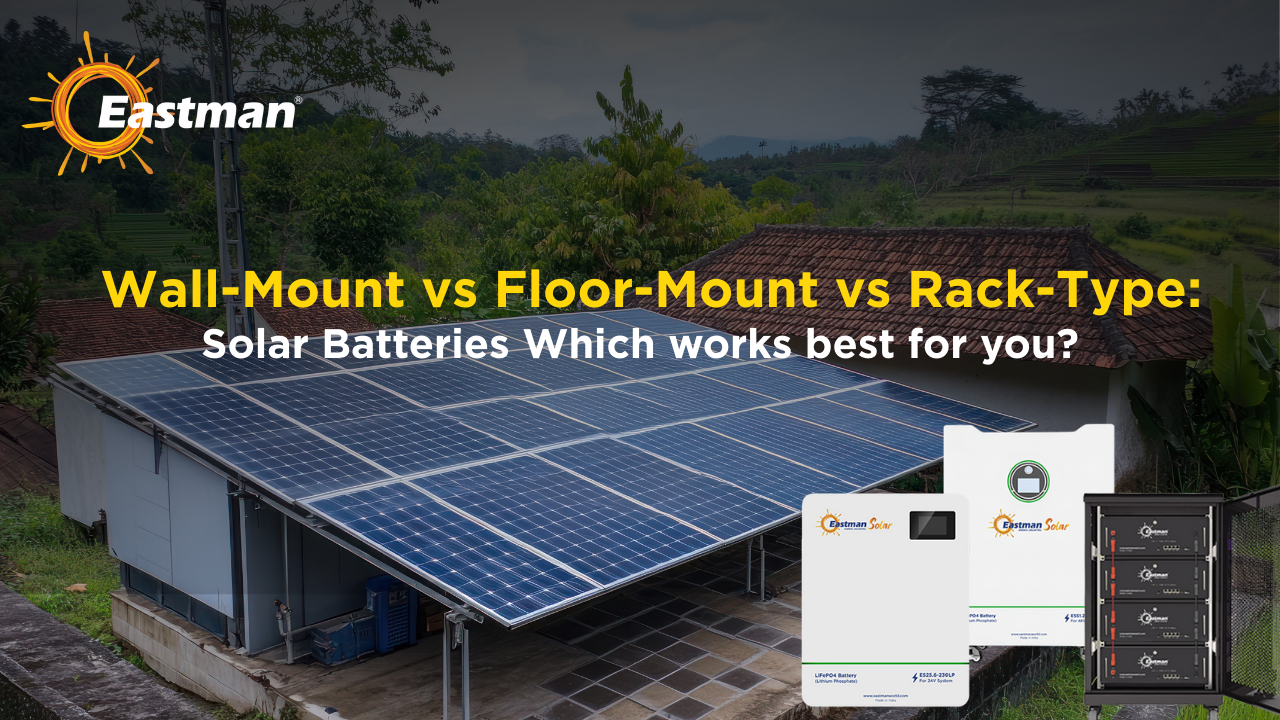
 Wall-Mount vs Floor-Mount vs Rack-Type: Solar Batteries What Works Best for You?
As solar adoption accelerates across residential and commercial sectors, energy storage has become the backbone of reliable solar power systems. While choosing the right solar inverter or panels is important, selecting the correct type of solar battery mounting system; wall-mounted, floor-mounted, and rack-type, is equally critical.
Each configuration is designed for different space availability, load requirements, scalability needs, and application environments. Choosing the wrong battery type can limit performance, complicate maintenance, or restrict future expansion.
This guide explains the differences between wall-mounted, floor-mounted, and rack-type solar batteries, their ideal use cases, and how to choose the best option for your home or business. We will also explore how Eastman offers versatile lithium battery solutions across all three categories to meet diverse energy needs.
Why Solar Battery configuration matters
Solar batteries do more than store energy; they determine how efficiently your solar power system operates, how easily it scales, and how safely it integrates into your space.
The right battery configuration helps:
1. Optimize available installation space
2. Improve system safety and accessibility
3. Enable future capacity expansion
4. Reduce downtime and maintenance challenges
5. Support different residential and commercial energy demands
Modern lithium batteries, especially LiFePO₄ technology, are now available in multiple form factors, making customization easier than ever.
Solar Battery Types: Overview
First, let’s briefly understand the three main solar battery types then we will compare them to know better:
1. Wall-Mounted Batteries- Compact, space-saving units mounted on walls.
2. Floor-Mounted Batteries- Standalone units placed directly on the floor.
3. Rack-Type Batteries- Modular battery modules installed in standardized racks.
Each serves a distinct purpose.
Wall-Mounted Solar Batteries explained
What Is a Wall-Mounted Solar Battery?
Wall-mounted solar batteries are compact lithium-ion battery units designed for secure wall installation. They are particularly popular in residential solar installations where floor space is limited.
Key Features:
a. Space-saving design
b. Lightweight lithium construction
c. Integrated Battery Management System (BMS)
d. Clean, aesthetic appearance
e. Easy access for monitoring and maintenance
Best Use Cases:
a. Homes and apartments
b. Small offices
c. Rooftop solar systems
d. Locations with limited floor area
Advantages:
a. Ideal for indoor installations
b. Keeps floors clear and organized
c. Quick installation and minimal civil work
d. Low maintenance due to lithium chemistry
Limitations:
a. Limited capacity compared to rack systems
b. Not ideal for high-load commercial applications
c. Expansion options may be limited
Wall-mounted lithium batteries are best suited for users seeking reliable backup, clean installation, and compact design.
Floor-Mounted Solar Batteries explained
What Is a Floor-Mounted Solar Battery?
Floor-mounted batteries are standalone units placed on the ground. They offer higher capacity than wall-mounted options while remaining simpler than rack-type systems.
Key Features:
a. Higher storage capacity
b. Stable and robust design
c. Indoor and outdoor compatibility
d. Integrated safety protections
e. Easy accessibility
Best Use Cases:
a. Large homes
b. Villas
c. Small commercial establishments
d. Shops, clinics, and offices
Advantages:
a. Handles higher power loads
b. Easier to upgrade than wall-mounted systems
c. No wall reinforcement required
d. Ideal for users expecting moderate future expansion
Limitations:
a. Requires dedicated floor space
b. Less scalable than rack-type solutions
c. Installation space planning is essential
Floor-mounted solar batteries strike a balance between capacity, flexibility, and ease of use, making them a popular choice for both residential and light commercial users.
Rack-Type Solar Batteries explained
What Is a Rack-Type Solar Battery?
Rack-type batteries consist of multiple lithium battery modules installed in standardized racks. These systems are engineered for high-capacity, scalable energy storage, especially for commercial and industrial applications.
Key Features:
a. Modular architecture
b. High energy density
c. Advanced BMS with cell balancing
d. Parallel battery expansion capability
e. Centralized monitoring
Best Use Cases:
a. Commercial buildings
b. Industrial facilities
c. Data centers
d. Hospitals and institutions
e. Large solar power plants
Advantages:
a. Highly scalable (can add modules as demand grows)
b. Supports heavy loads and long backup durations
c. Efficient space utilization for large capacities
d. Ideal for mission-critical operations
Limitations:
a. Higher upfront investment
b. Requires technical installation expertise
c. Dedicated battery room or enclosure needed
Rack-type lithium batteries are the preferred choice for businesses that demand reliability, scalability, and long-term energy planning.
Wall vs Floor vs Rack-Type Solar Batteries
Feature | Wall- Mounted | Floor-Mounted
| Rack-Type
|
Space Requirement | Minimal
| Moderate
| Dedicated |
Storage Capacity | Low–Medium
| Medium–High | High |
Scalability
| Limited | Moderate
| Excellent |
Installation Complexity
| Low
| Medium | High |
Ideal For | Homes
| Homes & Small Businesses
| Commercial & Industrial
|
Maintenance | Very Low
| Low
| Low (centralized) |
How to choose the right solar batteries for your needs
Before choosing the right solar battery ask yourself the following questions that will help you make the right choice:
1. What is your power requirement?
Low household loads can be handled by wall-mounted batteries, while high-load applications demand rack-type systems.
2. How much space do you have?
Limited space favors wall-mounted units, whereas commercial setups can allocate dedicated battery rooms.
3. Do you plan to expand later?
If future scalability is important, rack-type batteries are the most future-proof choice.
4. Is it residential or commercial use?
Residential users prioritize aesthetics and simplicity; commercial users prioritize capacity and scalability.
Why Eastman Solar Batteries Stand Out
With years of expertise in power electronics and energy storage, Eastman offers wall-mount, floor-mount, and rack-type LiFePO₄ solar batteries, allowing customers to choose the exact solution that fits their energy needs
Key Advantages:
1. We have advanced LiFePO₄ technology with 6000+ life cycles
2. We manufacture In- House and are proudly Made in India
3. Lithium batteries with 5 years of warranty
4. Backward integration for critical components (power electronics)
5. Built-in Battery Management System (BMS) for safety and performance
6. Real-time monitoring option through the Eastman One App
7. Seamless compatibility with Solar PCUs and hybrid inverters
8. Long warranty and robust after-sales support
9. Solutions designed for both residential & commercial applications
Eastman’s modular approach ensures customers are not locked into one configuration; they can scale, upgrade, or can customize as per energy demands.
Conclusion
Choosing between wall-mounted, floor-mounted, and rack-type solar batteries is not about which is better; it’s about which is right for your specific needs. Wall-mounted batteries suit compact residential setups; floor-mounted batteries offer flexibility for growing power demands, and rack-type batteries deliver unmatched scalability for commercial and industrial use.
With modern lithium technology and intelligent energy management, today’s solar batteries are safer, smarter, and more efficient than ever. Backed by versatile product offerings and proven expertise, Eastman enables homes and businesses to build reliable, future-ready solar energy storage systems.
Explore Eastman’s Wall-Mount, Floor-Mount & Rack-Type Lithium Solar Batteries; engineered for safety, scalability, and long-term performance.
Contact Eastman for more information.
Explore Eastman Wall-Mount battery solutions.
Explore Eastman Floor-Mount battery solutions.
Explore Eastman Rack-Type battery solutions.
Get to know your nearest Store Locator for convenience.
FAQ’s
Q. Which solar battery type is best for homes?
A. Wall-mounted or floor-mounted lithium batteries are ideal for residential use.
Q. Can rack-type batteries be used at home?
A. Yes, but they are typically recommended for high-capacity or large residential setups.
Q. Are lithium batteries safe for indoor installation?
A. Yes. LiFePO₄ batteries with BMS are safe and emit no harmful gases.
Q. Can I upgrade my battery capacity later?
A. Yes. Rack-type systems are highly scalable, while floor-mounted systems allow moderate expansion.
Q. How long do lithium solar batteries last?
A. Lithium batteries typically last 8–12 years or more, depending on usage.
 78728 78728