



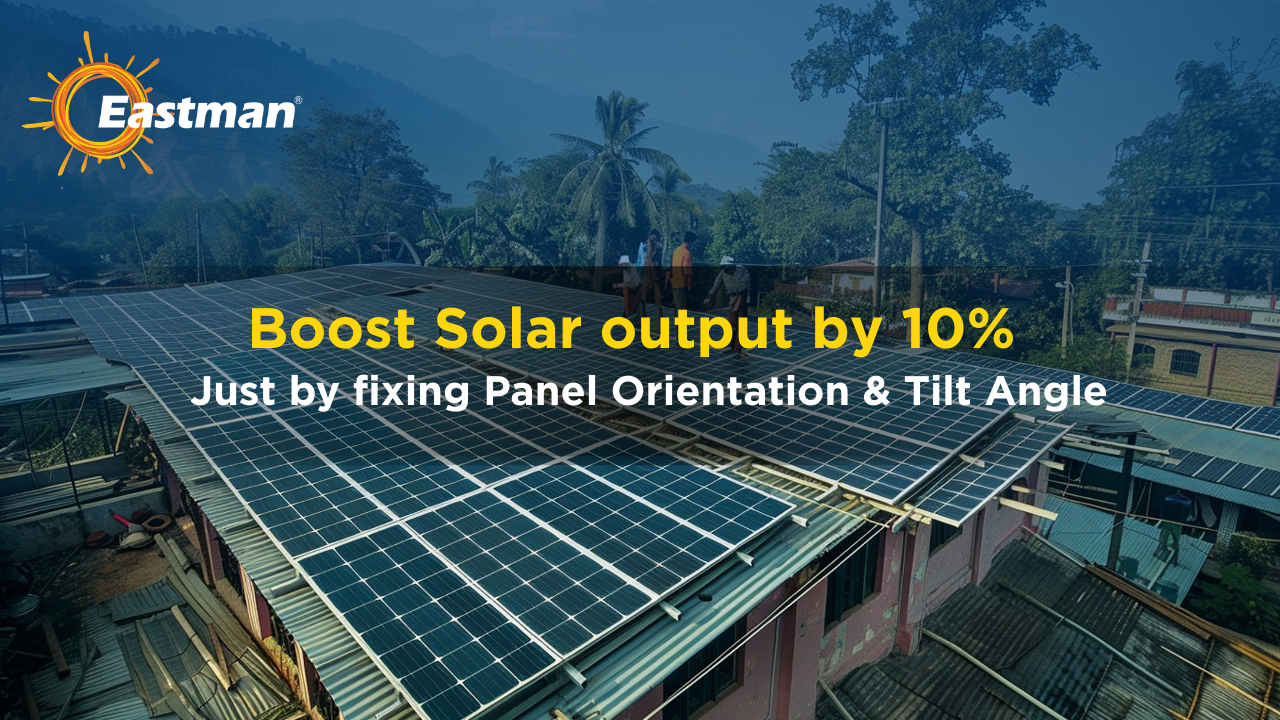
Boost Solar Output by 10% Just by Fixing the Angle
 February 24, 2026 / Solar Panel
 When homeowners and businesses install rooftop solar systems, most attention goes to: Panel efficiency, Inverter capacity, Battery storage, and Warranty period
However, one of the most overlooked factors that directly affects solar generation in India is solar panel orientation and tilt angle.
Even the highest-quality solar panels can underperform if they are not installed at the correct angle and direction.
Understanding how the tilt angle and orientation of solar panels affect output can significantly improve long-term ROI and energy production.
What is Solar Panel orientation?
Solar panel orientation refers to the direction the panels face.
In India, the optimal solar panel direction is generally south facing. This allows panels to receive maximum sunlight throughout the day.
If panels face:
1. South → Maximum annual generation
2. South-East / South-West → Slightly reduced output
3. East or West → Moderate reduction
4. North → Lowest efficiency
For best results, south-facing solar panel installations are recommended in India.
What is Solar Panel Tilt Angle?
Tilt angle refers to the angle at which panels are inclined relative to the ground. The best tilt angle for solar panels in India depends on:
1. Geographic latitude
2. Local weather patterns
3. Seasonal variations
Generally: Optimal tilt angle = Location latitude
For example:
1. Delhi (28° latitude) → 25–30° tilt
2. Mumbai (19° latitude) → 18–22° tilt
3. Chennai (13° latitude) → 10–15° tilt
This is known as a latitude-based solar tilt.
How does the tilt angle directly impact solar generation?
Solar panels perform best when sunlight rays hit them as close to perpendicular as possible. If the tilt angle is incorrect:
1. Reflection losses increase
2. Absorption reduces
3. Daily output drops
An improper angle of the rooftop solar installation can reduce annual generation by 5–15%. Over 25 years, this translates to significant energy loss.
Solar Panel Orientation: North vs South India Differences
India spans a wide latitude range, so tilt requirements vary regionally.
North India
1. Higher latitude
2. Requires a steeper tilt angle
3. Experiences larger seasonal variations
South India
1. Lower latitude
2. Requires a flatter tilt angle
3. More consistent solar path throughout the year
Therefore, the solar panel tilt angle in India must be customized according to the installation location.
Seasonal Tilt Adjustment: Is it necessary?
Some systems use seasonal tilt adjustment, where panels are adjusted twice a year:
A. Steeper in winter
B. Flatter in summer
This can improve annual output by 3–5%. However, most rooftop systems use fixed tilt due to:
1. Simplicity
2. Lower maintenance
3. Structural constraints
The choice between fixed-tilt and adjustable-tilt solar systems depends on installation type and budget.
Impact of Incorrect Orientation on ROI
Consider a 10-kW rooftop system.
If orientation is suboptimal and generation drops by 10%:
1. Annual energy loss can be substantial
2. Payback period may extend by several months
3. Long-term savings have reduced significantly
Proper solar performance optimization begins with the correct direction and tilt angle.
Roof Type and Tilt Limitations-
Not all rooftops allow ideal installation angles. Common challenges include:
1. Flat concrete roofs
2. Sloped tiled roofs
3. Shadows from adjacent buildings
4. Water tank obstructions
Mounting structures are often used to achieve optimal rooftop solar performance even on flat surfaces.
Solar Panel Efficiency Factors beyond Tilt
While tilt and orientation are critical, other solar panel efficiency factors include:
1. Temperature coefficient
2. Shading
3. Dust accumulation
4. Inverter quality
5. Wiring losses
However, tilt angle remains one of the simplest yet most impactful adjustments for improving output.
East-West Installations: When Are They Used?
In commercial or industrial rooftops:
1. East-West mounting is sometimes used
2. Allows higher panel density
3. Spreads generation across morning and evening hours
Although peak generation may be slightly lower, this layout can optimize space utilization.
Ground-Mounted vs Rooftop Installations
For ground-mounted systems:
1. Tilt angle can be optimized more precisely
2. Adjustable structures are easier to implement
For rooftop systems:
1. Structural strength and wind load must be considered
2. A balance between performance and safety is required
Proper engineering ensures both safety and improved solar generation potential.
How much extra energy can a proper tilt provide?
Studies indicate that correcting tilt and orientation can:
1. Improve annual generation by 5–12%
2. Reduce reflection losses
3. Improve winter performance
4. Enhance overall system efficiency
Over 25 years, even a 5% increase in output significantly boosts savings.
Eastman's Focus on Performance-Oriented Design
Eastman emphasizes quality system design along with high-performance solar components.
By ensuring:
1. Proper orientation planning
2. Optimized mounting structures
3. Durable installation materials
4. Compliance with Indian standards
Eastman supports improved solar output through thoughtful design and implementation across residential and commercial installations.
Correct system design enhances long-term performance stability and returns on investment.
Conclusion
When investing in solar energy, choosing quality panels and inverters is important, but so is the correct installation design.
Proper solar panel orientation and optimized tilt angle ensure:
1. Maximum sunlight exposure
2. Improved annual energy generation
3. Faster payback period
4. Higher long-term ROI
Whether in North or South India, customizing the tilt angle according to latitude and ensuring south-facing alignment significantly improves performance.
Solar success depends not only on technology but also on intelligent system design.
Contact Eastman for more information.
Explore Eastman Solar panels Solutions.
Calculate the Cost of solar solutions for your area.
Get to know your nearest Store Locator for convenience.
FAQ’s
Q1. What is the best solar panel tilt angle in India?
The ideal tilt angle is usually close to the location’s latitude. For example, Delhi requires around 25–30°, while Chennai requires around 10–15°.
Q2. Which direction should solar panels face in India?
South-facing solar panels generate the most annual energy in India.
Q3. Does tilt angle affect solar panel efficiency?
Yes. Incorrect tilt angles can reduce annual energy generation by 5–15%.
Q4. Can solar panels face east or west?
Yes, but energy generation may be slightly lower than that of south-facing installations.
Q5. Is seasonal tilt adjustment necessary?
Not always. Most rooftop systems use fixed tilts, but seasonal adjustments can slightly improve output.
Q6. Does orientation impact solar ROI?
Yes. Proper orientation improves generation, reducing payback periods and increasing long-term savings.
Q7. Are Eastman solar systems designed for optimal performance?
Yes. Eastman emphasizes proper system design and performance-focused installation to ensure reliable long-term output.
 78728 78728