


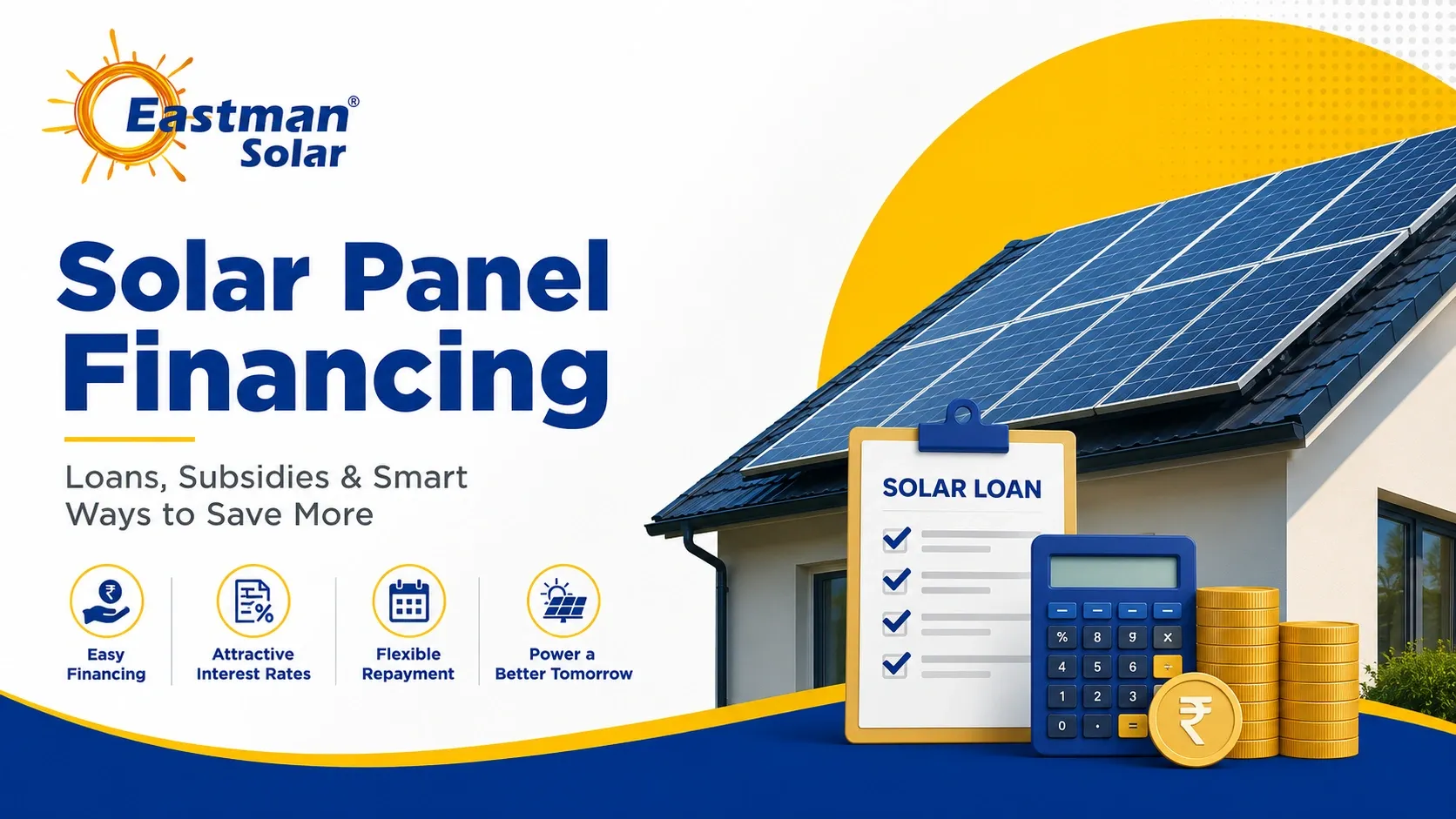
Solar Panel Financing: How to Make Rooftop Solar More Affordable?
 August 1, 2026 / Solar Panel
 Installing rooftop solar can reduce dependence on grid electricity, but the initial investment can still concern many households. You do not always need to pay the entire amount upfront.
Solar panel financing can help spread the installation cost across manageable monthly repayments. Government subsidies and potential electricity-bill savings can further improve the overall financial calculation. From secured and unsecured loans to business funding, several options are available for different requirements.
Let’s understand the financing choices, eligibility requirements, repayment considerations, and key factors to compare before choosing a suitable solar loan.
What is Solar Panel Financing?
Solar panel financing allows individuals or businesses to borrow money to purchase and install a solar energy system. The borrowed amount is repaid through Equated Monthly Instalments (EMIs) over an agreed period.
The loan may cover eligible equipment, installation, and related project expenses, depending on the lender. Borrowers can choose a suitable tenure based on their repayment capacity and project cost.
Types of Solar Loans Available in India
Solar loans generally fall into two categories based on collateral requirements. Understanding the difference can help you choose an option that suits your borrowing needs.
Secured Solar Loans
Secured solar loans require the borrower to provide collateral, such as property or a fixed deposit, subject to lender requirements. These loans may offer comparatively lower interest rates.
Indicative interest rates can range from approx. 15% to 16%, while repayment periods may extend up to 5 years. Actual rates and terms depend on the lender and borrower profile.
This option can suit larger residential systems and commercial or industrial projects requiring higher loan amounts. The collateral requirement should be assessed carefully before applying.
Unsecured Solar Loans
Unsecured solar loans do not require collateral, making them suitable for borrowers who prefer not to pledge an asset. However, eligibility may depend more heavily on income and creditworthiness.
Government-backed initiatives have increased access to residential rooftop solar loans. Public-sector banks also participate in schemes supporting eligible consumers under the Prime Minister's Surya Ghar Muft Bijli Yojana.
Borrowers should compare interest rates, processing fees, repayment periods, and other terms before selecting an unsecured loan. Solar power financing can therefore support solar adoption without a large upfront payment.
How Does the PM Surya Ghar Scheme Make Solar More Accessible?
The PM Surya Ghar: Muft Bijli Yojana supports eligible households with subsidised rooftop solar installations. By reducing the initial system cost, the scheme can make solar adoption easier for families and reduce their dependence on conventional electricity.
The scheme offers several benefits beyond household savings. It encourages renewable energy adoption, helps reduce carbon emissions, and is expected to lower the government's electricity expenditure through greater solar generation.
Key benefits of the PM Surya Ghar Scheme:
- Lower Household Electricity Costs: Subsidised rooftop solar can help households generate their own electricity and reduce monthly bills.
- Government Cost Savings: The scheme is expected to help the government save around ₹75,000 crore annually in electricity costs.
- Greater Renewable Energy Adoption: It encourages more households to shift towards solar power and supports India's renewable energy goals.
- Lower Carbon Emissions: Increased solar generation can reduce dependence on conventional power sources and contribute to lower carbon emissions.
The subsidy support depends on the household's average monthly electricity consumption and the suitable rooftop solar capacity.
| Average Monthly Electricity Consumption | Suitable Rooftop Solar Capacity | Subsidy Support |
|---|---|---|
| 0-150 units | 1-2 kW | ₹30,000-₹60,000 |
| 150-300 units | 2-3 kW | ₹60,000-₹78,000 |
| Above 300 units | Above 3 kW | Up to ₹78,000 |
The subsidy can reduce the amount you need to arrange upfront or finance through a solar loan. This can make the overall cost of installing a rooftop system more manageable.
Eastman Auto and Power Limited aligns with this shift towards accessible solar energy by offering solutions for hybrid and on-grid solar panels, helping households choose systems based on their energy requirements and usage patterns.
Who can Apply for a Residential Solar Loan?
Lenders generally assess the applicant's age, income, credit profile, and electricity connection before approving a solar loan. These factors can determine eligibility for home solar financing, though specific requirements differ between lenders.
Common criteria may include:
- Indian resident
- Salaried or self-employed applicant
- Typical age range of 21-65 years, depending on the lender
- CIBIL Score criteria mentioned by the financing partner
- Valid electricity connection or acceptable No Objection Certificate (NOC)
- Installation through an empanelled vendor
Documents Required for a Solar Panel Loan
Applicants may need to provide identity and address proof, Permanent Account Number (PAN), income documents, and recent bank statements.
The lender may also request an electricity bill, solar system quotation, and vendor-related documents. Secured loans can require additional collateral documents.
6 Factors to Consider Before Taking a Solar Loan
Before selecting a loan, look beyond the advertised interest rate and assess the complete cost and repayment structure, especially for solar power plant financing.
1. Processing Fees
Lenders may charge processing fees when the loan is originated. Compare these charges as part of the total borrowing cost.
2. Prepayment and Foreclosure Charges
Check the charges applicable to early repayment or foreclosure. This is particularly important if you plan to use additional funds or subsidy proceeds to reduce the outstanding loan.
3. Disbursement Structure
Understand when the lender releases funds and if payments are made in stages. Some lenders may disburse funds directly to the solar vendor.
4. Fixed vs Floating Interest Rate
A fixed rate offers greater repayment predictability, while a floating rate can change during the loan period. Compare the potential impact on your EMI.
5. Loan-to-cost Ratio
Check how much of the total installation cost the lender will finance. If the lender funds only part of the project, you may need to arrange the remaining amount yourself.
6. Total Cost of Borrowing
Compare interest, processing fees, prepayment charges, and other applicable costs. Looking at the overall repayment amount can help you assess different solar panel financing options more accurately.
How to Apply for Solar Panel Financing
The application process generally involves the following steps:
- Estimate your solar project cost based on the system size and installation requirements.
- Check your eligibility based on income, credit profile, and lender criteria.
- Compare loan options based on interest rates, tenure, fees, and financing limits.
- Prepare the required documents for credit and project verification.
- Submit the application and complete the lender's verification process.
- Arrange loan disbursement according to the agreed installation schedule.
Make Your Rooftop Solar Investment Work Smarter
Financing can reduce the immediate financial burden of installing a rooftop solar system. Instead of paying the entire project cost upfront, you can distribute the expense across a defined repayment period.
Government subsidies can reduce the amount you need to finance for eligible residential projects. You can also check for applicable state-level subsidies to access additional financial benefits. In addition, savings on electricity bills can help you manage monthly loan repayments.
Ready to switch to rooftop solar? Explore Eastman’s solar solutions, compare your options, and choose a system that suits your energy needs and budget.
 78728 78728